Category Archives: Arts and Culture

Mehendi

I blogged a couple weeks ago about the importance of the month of Shrawan to women.  Many of the activities this month lead up to Teej (which, by the way I had mistakenly said was in July but which is actually near the end of August) and another important practice for many high caste, Brahmin Hindu women is the application of beautiful mehendi designs of intricate details to the palms of their hands. Traditionally, they apply the henna the night before the first day of the month of Shrawan, which was Wednesday night this week.

The ready-mixed henna paste is stuffed into a foil cone that narrows to a pin prick at the bottom (in fact a pin is inserted in the narrow end of the cone to keep the henna inside the cone).  You can buy the dry powder but the cone is just much easier, especially for a novice like me.  Remove the pin and gently squeeze the cone to release a narrow thread of the paste.

Before applying the henna women first, coat their palms with lemon juice or sugar water and let it dry. This helps the paste adhere really well to the skin and not flake off.  Many women will apply the henna on the last night of the month of Bhadra and sleep with the henna on their hands until the next morning.  It really does stick like glue to skin and can be difficult to get off, although it still feels a bit crunchy, like applying a face mask to your hand.

I timidly began to draw a design, having no idea what would be suitable.  My colleague from work gave me a few ideas which was good asI think it helped make it look more authentic.  But it was hard to get it as detailed as I would have liked.  I saw some women on the bus the next day whose hands were so finely decorated it look like a red lace glove on their hand.

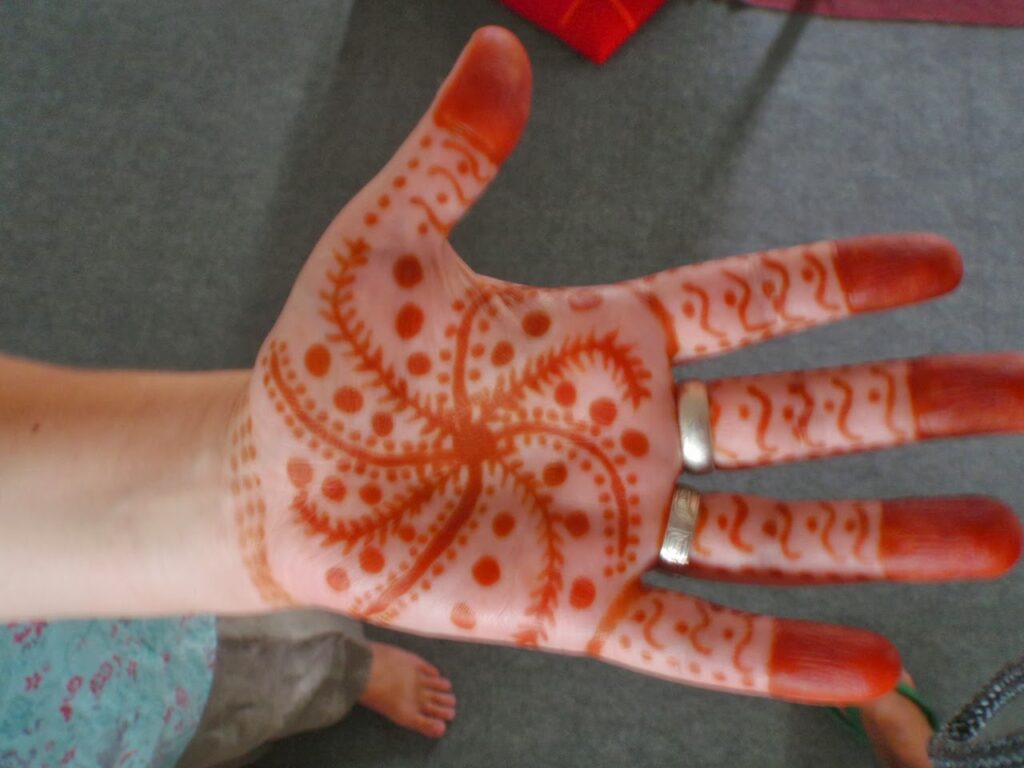
Below is a before and after picture of my first attempt – not too bad I think! Apparently, the darker the henna stains, the more your husband loves you…they say mine was very dark… 🙂
OLYMPUS DIGITAL CAMERA
My hand with Mehendi still on
My hand with mehendi still on

Honouring Fridays: July 10th, 2009

We are rounding the corner to the end of month 8 in Nepal.  It is really, really hard to believe.  But when I look at my life here, maybe it’s not so hard to believe after all.  I barely notice the roving cattle in the middle of the busy streets, I am adept at dodging various forms of excrement on the sidewalk, I didn’t blink when I saw the fruit man sharpening his knife on the edge of the curb, I feel naked with a jauntily tossed scarf around my neck, mangos have become their own food group, I can jump from taxi-micro-bus-tuk-tuk easily and without hesitation, I walk into oncoming traffic regularly and am confident that a brief wave of the hand will allow me to cross safely, and I am starting to think that the earlier in the day one gets to eat something curried, the better.

  • Teej. Shrawan is the name of the Nepali month from mid-July to mid-August.  Typically, all Nepali months are about the same length as Roman calendar months but they begin halfway through a Roman month and end halfway through the next Roman month.  Shrawan is an important month on the Nepali calendar for women.  During this month is the celebration of Teej.  Teej is a festival of women filled with dancing, singing, ritual bathing, and fasting for up to 3 days.  Red clothes are typically worn during this time to symbolize joy and happiness, reflecting also the marriage ceremony when women wear red saris.  Married women pray for happy marriages and healthy, long lives for their husbands.  Unmarried women pray for finding a good husband.  What I appreciate is a whole month with a strong focus on women.  True, the focus is on the role of women as wives, which seems limited and perhaps slightly old fashioned, but here in Nepal this is a very important role.  For me, it will be more about women coming together in kinship, spirit, and celebration.  And I did buy some green glass bangles, which promote health and good blessings for your husband…can’t hurt right?
  • My new lunch spot. With the new office move I found myself without the common comforts of my old office. Most notably lunch!  We had such lovely daal bhaat and curried vegetables every day and the thought of packing a lunch and slogging it all the way to work was unappealing.  So, I and my colleague Sujata, stepped out to find a nearby eatery.  We walked about 10 meters down the road.  And stopped.  And there was a lovely, small, local, and bustling shop.  Owned by a gracious and kind family that has developed a strong customer base from the private school next door – oodles of uniformed children stop there for snacks after class.  They sell some of the best samosas, alu chop (like a heavily spiced, chickpea flour coated, deep fried, mashed potato finger), and vegetable momos I have found in my time in Nepal.  And the momos are about 25 NPR which is about 25 cents….hard to beat.  Now we go twice a day – once in the morning for tea and samosas and once for lunch of momos, chops, and a cool Sprite.
  • Homemade Sun Tea.  Easily one of the most thirst quenching, satisfying, and quick drinks to make.  Tea is plentiful, sugar is local, and small lime/lemons – kargatti – are always available.  Plus, the regular and intense sunshine makes perfect sun-tea!  I read the numerous warnings about the health risks of sun tea (seriously?) and decided that the risks for sun tea and decidedly less risky than most of the other food I ingest on a daily basis.  I have taken to using flavoured teas like raspberry and peach (can’t get the real fruit here so the subtle flavour infused in the tea satisfies the basic need).  Topped with some sugar and fresh squeezed kargatti – delicious!
  • Gandharba musicians. One of my great VSO colleagues, Raj, comes from the musical Dalit caste, also called the Gandharba caste.  Historically, castes were formed by grouping certain professions.  Professions that were considered favourable, powerful, or prestigious are upper castes.  And those that were considered menial, degrading, or sacrilegious were deemed lower caste.  The arts, overall, were considered low caste professions and as such many of the Nepali artists belong to the Dalit caste.  Raj is passionate about his history and spends every free moment, when not working on VSO stuff,  promoting, sharing, and enhancing the public awareness of the Gandharba caste.  Today he was featured on a national radio program, he regularly writes articles for various publications, has won international awardsfor his work on Dalit issues, and he has recently helped to create a relationship with a musical school in India which provides a scholarship to one Nepali musicians each year and has just begun to offer a course in traditional Nepali music.  I am grateful for all he does to work on behalf of Dalits in Nepal, especially the very talented Gandharba musicians.  To download some Gandharba music to sample look here.