Tag Archives: culture

Honouring Fridays: August 29th, 2009

Call me crazy, but I think I feel a chill in the air.  The temperature dipped below 20 degrees and as we scrambled to get the blankets back on the bed I realized just how much my internal thermometer has shifted.  Since when did 20 degrees become cold?  And how much will I shiver when I get home and an hour of rain isn’t followed by blazing hot sunshine?  But perhaps it isn’t temperature at all, but rather old habits driving this need to cozy up – with September around the corner it somehow just feels like the right thing to do.

  • Work days that allow for a quick venue research trip up a mountain to resort-ish type location where one can see the Himalayan vistas. Need I say more?  In comparison it would be like being asked to visit Whistler (albeit much less fancy) for a day and report back on the quality of the hotel rooms, meeting halls, and menus of possible workshop venues.   And our selection was…Hotel Country Villa.  Beautiful rooms, fantastic food and excellent (read inspiring) views.  Sigh…work is tough some days!  The only piece of this day that I was not as grateful for was the screeching and precariously speedy trip up the mountain side to get to said location.  Thankfully, I was not riding on the roof of a public bus…it was scary enough from the backseat of a car.
  • Pothole warnings.  due to some very heavy rainstorms lately, some of the paved roadways are developing rather large, almost crater like, holes.  On my regular walking route to the tuk-tuk stop I had noticed some sinking spots in the pavement.  But literally overnight, these sink holes had sunk to new lows…giant hollow spaces beneath the pavement, much like cracking the head of a chocolate Easter bunny – the hole may look small from the top but is cavernous underneath.  So, to warn drivers who are speeding through the streets the neighbourhood solution is to prop a tall tree-like branch into the hole.  No bright tape, coloured ribbons, massive orange cones, or heavily roped off areas.  Just a bamboo branch waving lazily in the breeze and blending very wall into the surroundings.  I admit the holes were fixed within a week, an excellent turnaround time for Nepal, but Iam still left marveling at the simplicity of it all.
  • Being able to get work done in a cyber. Cyber is Nepali speak for an internet cafe – minus the cafe.  A bunch of old computers crammed into a small shop along with phone booths, a copy machine, and some dusty office supplies.  Speeds vary, monitors are often discoloured and flickering, and keyboards have notoriously sticky keys.  But right now, we have no internet in our office and have not had for the past 3 months.  So, this means regular trips to the local cyber to check and answer email.  And I am still somewhat shocked (and grateful!) for the amount of work we manage to do in these little cybers.  The noise level is ridiculous, with locals calling family gone to work in the Middle East and yelling over a poor reception, the ergonomics would make any office rep cringe, and there are always a gaggle of folks reading email over your shoulder.  However, with a bit of focus and preseverance we have managed to operate this way for 3 months.  Not ideal, but somehow satisfying.  And a tribute to a culture like Nepal where people simply are not bothered by these small inconveniences.
  • Peanut butter cookies.  It was a moment of madness and I was blinded by a recollection of smell and taste.  I had been dreaming about this particular version of peanuttyness for a few weeks but thought that the feeling would wear off.  It didn’t.  It got worse.  So, after trying desperately to ignore it, I caved and sent R on a scrambling race to the corner store for some peanut butter and baked out my craving with only moments to spare before the power cut started for the evening.  They were delicious and I think worth the madness.  My only excuse is that it was a back-to-school treat (without the back to school part)!
Mehendi

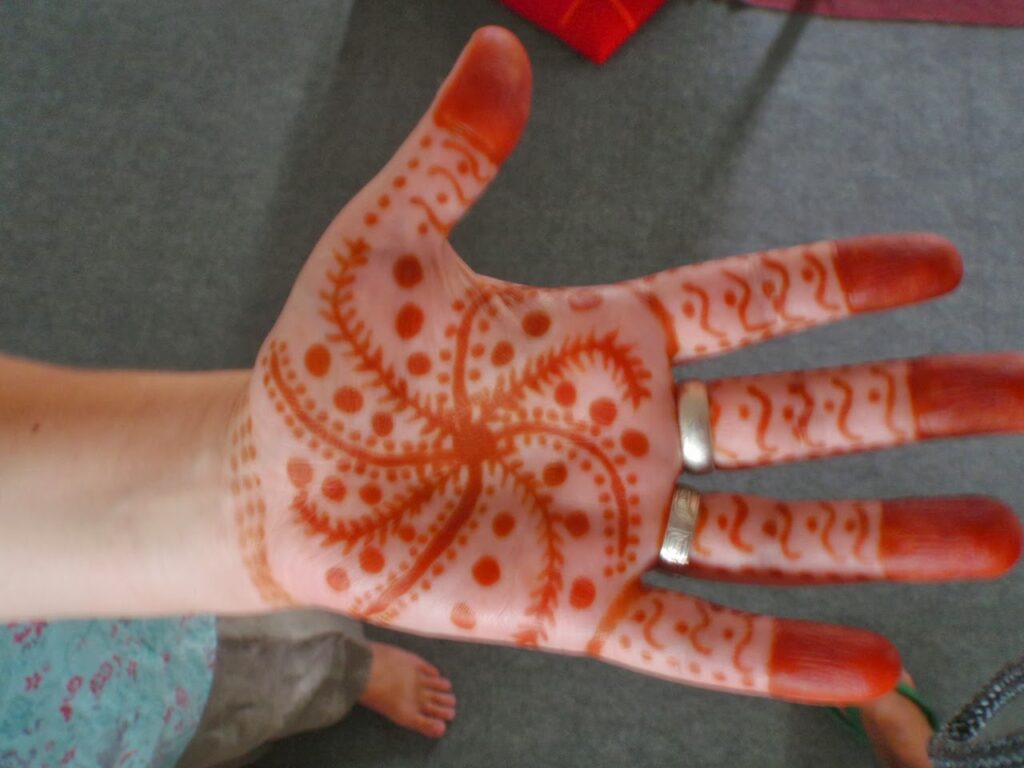
I blogged a couple weeks ago about the importance of the month of Shrawan to women.  Many of the activities this month lead up to Teej (which, by the way I had mistakenly said was in July but which is actually near the end of August) and another important practice for many high caste, Brahmin Hindu women is the application of beautiful mehendi designs of intricate details to the palms of their hands. Traditionally, they apply the henna the night before the first day of the month of Shrawan, which was Wednesday night this week.

The ready-mixed henna paste is stuffed into a foil cone that narrows to a pin prick at the bottom (in fact a pin is inserted in the narrow end of the cone to keep the henna inside the cone).  You can buy the dry powder but the cone is just much easier, especially for a novice like me.  Remove the pin and gently squeeze the cone to release a narrow thread of the paste.

Before applying the henna women first, coat their palms with lemon juice or sugar water and let it dry. This helps the paste adhere really well to the skin and not flake off.  Many women will apply the henna on the last night of the month of Bhadra and sleep with the henna on their hands until the next morning.  It really does stick like glue to skin and can be difficult to get off, although it still feels a bit crunchy, like applying a face mask to your hand.

I timidly began to draw a design, having no idea what would be suitable.  My colleague from work gave me a few ideas which was good asI think it helped make it look more authentic.  But it was hard to get it as detailed as I would have liked.  I saw some women on the bus the next day whose hands were so finely decorated it look like a red lace glove on their hand.

Below is a before and after picture of my first attempt – not too bad I think! Apparently, the darker the henna stains, the more your husband loves you…they say mine was very dark… 🙂

OLYMPUS DIGITAL CAMERA
My hand with Mehendi still on
My hand with mehendi still on

Politics in Nepal

Up to this point, I have not spent much time commenting on the political situation in Nepal.  My first hesitation is that I am hardly a reliable source of information about the political situation – I have only been here 2 months and most of that time we have spent under the kind and watchful eye of VSO or our dedicated language teachers at CLP.  What could I possibly know?

And, what I do observe and hear through both Nepalis and foreigners is so mixed and fraught with opinion that it is often difficult to know what to believe, let alone make some sense of it for myself.

But, with those hesitations clearly stated at the outset (I am certainly not an expert and everything I say is filtered through not only my lens but often the lens of a dozen other people too, thus losing it’s initial meaning) I will toss out some careful observations to shed some light on what is happening politically here.

First, the newly elected government, a coalition of many different parties, is under huge pressure to re-write a new constitution quickly.  To this end, it is natural that many different groups are keen to ensure that their needs and wants are reflected in this important document.  With a staggeringly large number of ethnic groups, languages, religions, and terrains, this is a exceptionally difficult task – difficult for each group to ensure their voice is heard in the clamour and difficult for the government to bring all these voices into one collective vision for the country.

Second, Nepal is in a unique position as the intersection between the giants of China and India and have always been acutely aware of just how relationships with these nations will impact them.  They want to reflect their unique culture (to the point of having their own time zone that is 15 minutes behind India…makes watching TV confusing as all shows begin at 15 and 45 minutes past the hour) while maintaining good political relationships. And having never been colonized as a nation, they are, with good reason, very protective of their culture.

Third, the culture around advocacy, lobbying, and petitioning the government has grown to be very centered around disruption of daily life – after hundreds of years of not being listened to, I can see how frustration and anger would build to a breaking point – but it significantly impacts many aspects of life in Nepal, from transportation, to access to power and water, to targeted attacks on the perceived oppressor.  The outlet that is available to many of those citizens who are angry is one of confrontation, which sadly has not led to much noticeable change over the years…and yet with few other options it is hard to chastise people who simply want to be heard.

And like every political system out there, there are the added complexities – scandals, nepotism, inaccurate representation by marginalized groups, personal agendas, power struggles, urban centres receiving more attention, publicity stunts, lots of hot air from those in power, and a shuffling of priorities every time those in power are shuffled around.

Amazing how anything gets done anywhere really 🙂

Nepal is not unlike many other nations striving to identify itself and trying to do the best they can with what they have.  I do not envy the difficult job of politicians in Nepal nor am I without great sympathy for the many people who have been oppressed here for a number of years.