Tag Archives: festivals

Honouring Fridays: September 4th, 2009

The countdown to September 15th has kicked into full gear! The excitement of 4 weeks of vacation combined with visitors from home arriving on that day is making the days fly by. Plus September and October hold the biggest Hindu festivals (akin to Christmas in Christian countries). First is Dashain which is a large, 10-day, family celebration with lots of sacrifices, meat eating, dancing, singing, and returning to home villages to give prayers and offerings to family members. Then about 2 weeks later is Tihar (like Diwali in India) the festival of light. So, lots of joy and celebration ahead has left me feeling incredibly grateful this week – the cup runneth over with goodness, prosperity, and happiness!

  • Pants with no holes. Such simple pleasures really. After toting some rather tired-looking clothes to Nepal, hoping that they would wear themselves out while here, I discovered that they listened. But only in the form of large holes in the crotch (too much information? sorry), while the rest of the fabric is like new! Ordinarily, I would just buy myself a new pairs of pants, but when your entire 4-pair pants wardrobe is in cahoots and decides to commit collective suicide and to reveal your bits to the world, it means war. So, those old pants got a new lease on life this week thanks to a neighbourhood tailor. After trying about 6 different shops and getting full belly laughs from the proprietors about my large-thigh problem, I finally found a man who was willing to help. Granted, he and his friend spent a good ten minutes exclaiming and laughing to each other about how fat I was, but finally he agreed to help. The solution, while not perfect but absolutely acceptable, was to cut about 3 inches of length from the cuffs and use those two pieces to sandwich the weak fabric in the middle. So, 4 days later and they are as good as new…we will just overlook the fact that my entire pants wardrobe is now an awkward mid-ankle crop…
  • Cinnamon rolls. I inherited a big jar of yeast from a friend who was moving back to Canada from Nepal (Hi Anne! Say hello to Vancouver for us!), along with a great big bag of walnuts and an almost full can of dark Canadian maple syrup (and many many other lovely kitchen items…I am also grateful for hand-me-downs!). Inspired to bake something that reminded me of home, I quickly decided on the comforting yeasty-ness of cinnamon rolls. When I was younger my mom would sometimes get up very early and bake us fresh cinnamon buns before school…such a treat (I also remember the homemade elviss mcmuffins…real cheddar, English muffins, egg…my absolute favourite!). The husband loved them – he ate most of them in fact – and the maple walnut crunch with cinnamon was delicious! The bun recipe was an adaptation of The Pioneer Woman’s but instead of the maple glaze on top I  slathered inside butter, maple syrup, and cinnamon.  It may not feel like Fall here but it sure did taste like it!
  • Money. The pain was all worth it. I received word this week that the National Campaign for Education, Nepal (NCE Nepal) with whom I am working, has been approved for a rather large sum of money for this year and two more years funding contingent on success this year. It amounts to about $100,000 USD, in Nepali rupees is close to 7,769,999.69 NPR. To put this into context the majority of Nepali families in villages live on 3000-4000 NPR or less per month…this is BIG money! The proposal writing process was probably one of the most painful and exhausting times I have had here in Nepal but I couldn’t be happier that at least it was all worth it. This will be enough to hire two more staff and do some really exciting work on education advocacy including research, policy advocacy, and setting up regional advocacy networks. So, it is an exciting and wealthy time for NCE Nepal. It makes me slightly sad to be leaving and unable to see the implementation of all these great ideas. But it leaves them in a good spot…all I can do now is hope they use it effectively and ethically.
  • English translation errors. Last weekend we went up to near the Tibetan border to stay at a lovely resort called Last Resort. A beautiful and peaceful place to recharge the internal battery and refocus on what is inspiring about Nepal. We enjoyed the company of good friends, good food, and adventure! But I also enjoyed this – almost more than anything…I am still chuckling about it actually. 🙂   Whoops!   Just a bit more space needed between the first 2 options and the last option, unless of course vegetarian is in fact a new gender!  And I was thinking that this would be a good submission to Engrish.
Honouring Fridays: July 10th, 2009

We are rounding the corner to the end of month 8 in Nepal.  It is really, really hard to believe.  But when I look at my life here, maybe it’s not so hard to believe after all.  I barely notice the roving cattle in the middle of the busy streets, I am adept at dodging various forms of excrement on the sidewalk, I didn’t blink when I saw the fruit man sharpening his knife on the edge of the curb, I feel naked with a jauntily tossed scarf around my neck, mangos have become their own food group, I can jump from taxi-micro-bus-tuk-tuk easily and without hesitation, I walk into oncoming traffic regularly and am confident that a brief wave of the hand will allow me to cross safely, and I am starting to think that the earlier in the day one gets to eat something curried, the better.

  • Teej. Shrawan is the name of the Nepali month from mid-July to mid-August.  Typically, all Nepali months are about the same length as Roman calendar months but they begin halfway through a Roman month and end halfway through the next Roman month.  Shrawan is an important month on the Nepali calendar for women.  During this month is the celebration of Teej.  Teej is a festival of women filled with dancing, singing, ritual bathing, and fasting for up to 3 days.  Red clothes are typically worn during this time to symbolize joy and happiness, reflecting also the marriage ceremony when women wear red saris.  Married women pray for happy marriages and healthy, long lives for their husbands.  Unmarried women pray for finding a good husband.  What I appreciate is a whole month with a strong focus on women.  True, the focus is on the role of women as wives, which seems limited and perhaps slightly old fashioned, but here in Nepal this is a very important role.  For me, it will be more about women coming together in kinship, spirit, and celebration.  And I did buy some green glass bangles, which promote health and good blessings for your husband…can’t hurt right?
  • My new lunch spot. With the new office move I found myself without the common comforts of my old office. Most notably lunch!  We had such lovely daal bhaat and curried vegetables every day and the thought of packing a lunch and slogging it all the way to work was unappealing.  So, I and my colleague Sujata, stepped out to find a nearby eatery.  We walked about 10 meters down the road.  And stopped.  And there was a lovely, small, local, and bustling shop.  Owned by a gracious and kind family that has developed a strong customer base from the private school next door – oodles of uniformed children stop there for snacks after class.  They sell some of the best samosas, alu chop (like a heavily spiced, chickpea flour coated, deep fried, mashed potato finger), and vegetable momos I have found in my time in Nepal.  And the momos are about 25 NPR which is about 25 cents….hard to beat.  Now we go twice a day – once in the morning for tea and samosas and once for lunch of momos, chops, and a cool Sprite.
  • Homemade Sun Tea.  Easily one of the most thirst quenching, satisfying, and quick drinks to make.  Tea is plentiful, sugar is local, and small lime/lemons – kargatti – are always available.  Plus, the regular and intense sunshine makes perfect sun-tea!  I read the numerous warnings about the health risks of sun tea (seriously?) and decided that the risks for sun tea and decidedly less risky than most of the other food I ingest on a daily basis.  I have taken to using flavoured teas like raspberry and peach (can’t get the real fruit here so the subtle flavour infused in the tea satisfies the basic need).  Topped with some sugar and fresh squeezed kargatti – delicious!
  • Gandharba musicians. One of my great VSO colleagues, Raj, comes from the musical Dalit caste, also called the Gandharba caste.  Historically, castes were formed by grouping certain professions.  Professions that were considered favourable, powerful, or prestigious are upper castes.  And those that were considered menial, degrading, or sacrilegious were deemed lower caste.  The arts, overall, were considered low caste professions and as such many of the Nepali artists belong to the Dalit caste.  Raj is passionate about his history and spends every free moment, when not working on VSO stuff,  promoting, sharing, and enhancing the public awareness of the Gandharba caste.  Today he was featured on a national radio program, he regularly writes articles for various publications, has won international awardsfor his work on Dalit issues, and he has recently helped to create a relationship with a musical school in India which provides a scholarship to one Nepali musicians each year and has just begun to offer a course in traditional Nepali music.  I am grateful for all he does to work on behalf of Dalits in Nepal, especially the very talented Gandharba musicians.  To download some Gandharba music to sample look here.

Shiva Ratri

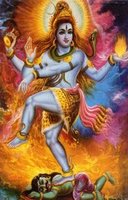
Today, February 23rd, is a special holiday in Hindu culture called Shiva Ratri.  The festival honours the Lord Shiva, the Destroyer.  It is a day of worship to celebrate and honour Lord Shiva and many followers flock to Pashupatinath Temple for a dip in the holy Bagmati river.  The temple is also crowded with sadhus, holy men, who devote their lives to a material free existence and concentrate on their relationship with the gods.  Shiva Ratris, historically, was when the sadhus would arrive in Kathmandu to receive their free marijuana from the government which would help their quest for spiritual enlightenment.  Thus, today, many Hindus partake in smoking of marajuana since it is the only day of the year when it is legal to smoke marijuana in Nepal.

But more locally, Shiva Ratri is an opportunity for local children to gain some money.  Children create small barricades of rope across small lanes and request rupees to allow any passerby access.  The really devoted ones have incense, pictures of Lord Shiva, and pujaa (offerings) or rice, marigold flowers, and red powder on a tray into which you can place your rupees.  I made a small journey of about 20 minutes to a local restaurant and was completely stripped of all my coins!  I hit about 8 roadblocks and was happy to hand over a few rupees to the groups.  Only once was I chased down and wrapped in rope because they wanted more money…a few stern no’s was enough to untangle myself from the ropes and keep moving.

The next big festival will be on March 10th, Holi Day, which is a festival of colour.  This is the day that balloons of dye and pigment rain down from the balconies of buildings, mostly targeting the folks passing by 🙂  I actually think this will be a fun festival to participate in, providing I find some cheap clothes to wear and find places where they don’t throw the balloons too hard – apparently it can be dangerous to be female and non-Nepali as you are most definitely a target!